
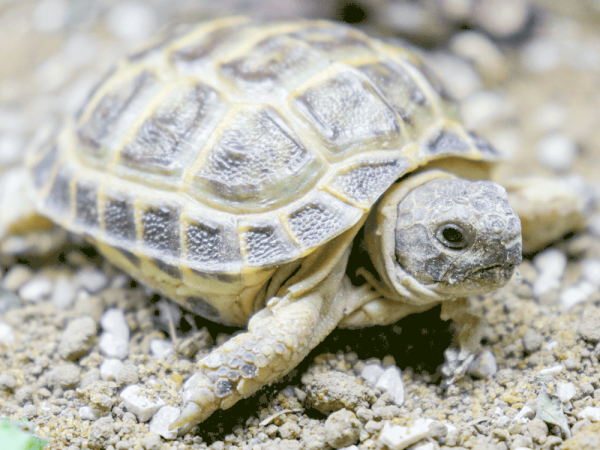
HOUSING
The minimum recommended adult enclosure size for a Mediterranean tortoise is:
Length 5ft x Depth 3ft x Height 2ft (60” x 36” x 24”) There aren’t many branded enclosures of this size, most people tend to custom build them, however the most popular starter enclosures are the Vivexotic Tortoise Table or the Habistat Tortoise Table.
This in no way means that you can’t go bigger if you have the space, Tortoises can be quite active and would further be enriched by more space.
Mediterranean tortoises reach full size between 10-20 years (depending on your sub-species) so it’s recommended to start them off in a smaller enclosure and gradually upsize them as they grow. The two enclosures listed above can last your tortoise 3-5 years depending on the tortoises growth rate & maintenance of the table.
LIGHTING & EQUIPTMENT
Mediterranean tortoises are diurnal animals, which means in the wild they would spend most of their waking hours in in the sunlight. During this time in the wild they would have constant exposure to mid-levels of UV. Like all Reptiles they need a Day/Night cycle of 10-12hrs so all lighting must be turned off at night.
We recommend a Heat & UV Mercury vapor combined bulb such as a 100w Arcadia D3 Basking light, or alternatively have a 12% T5 strip light with a separate basking bulb on a dimming thermostat. These strip lamps are popularly available in 2 brands – Arcadia ProT5 kits or Reptile Systems ECO Units. As these are fully terrestrial ground-dwelling species, we do not recommend a UV percentage stronger than 12%.
HEATING
Tortoises are diurnal and need heating from above as they take all their heat in through the top of their bodies through basking. Because of this they need access to a basking spot from a above. Because of the way these reptiles absorb heat, heat mats are not an efficient long-term primary heat source as it doesn’t allow for the animal to bask.
The best way to measure your temperatures is with an infrared thermometer, which lets you check the temperatures across the tank; however, a standard digital thermometer will do the trick for just measuring the basking spot.
Their basking temperatures should be approximately 28°c-35°c, Tortoises need a gradient I their house with the coolest area reaching at least 22°c
If using a separate basking spot from UV, we recommend a minimum of 100w heat lamp in controlled by either a microclimate or habistat dimming thermostat, alternatively you can use an Evo or Day/night thermostat to automate all aspects of your heating providing they have a dimming function
In most houses, additional heating at night is not required, however if your house regularly drops below 10°c at night you may need to look into nighttime heating such as CHEs on a separate pulse stat.
HUMIDITY
As babies, maintaining a low-ground humidity of 40-70% is vital for their health as it is a factor in keeping their shells healthy.
DIET & FEEDING ROUTINE
Mediterranean tortoises are considered to be primarily herbivores, however in the wild they are opportunistic insectivores, occasionally feeding on earth worms and isopods that live on the organic matter they would naturally graze on.
Our tortoises here are fed on a high fiber diet predominantly consisting of wild collected weeds such as; Plantain, dandelion leaves, clover, dead nettles, horse parsley, creeping thistle, walls lettuce & much more. However, we do supplement their diet with safe houseplants such as spider plant, callisa & lemon balm, but you should make sure if you’re offering these that they have no pesticide or non-organic fertilized used in their potting mixes.
Treats
Treat food should be offered in extreme moderation as a lot of the popular ‘treat’ foods can do more harm than good if given too frequently, it can cause a lot of internal health problems in your animal. The main thing is to consider that tortoises have no concept of treats and would not naturally find high-sugar fruits and vegetables in the wild, and offering them foods such as strawberries, tomatoes, or other soft fruit is often for your benefit rather than theirs.
Supplementation
All food that you’re giving to your tortoise should have the appropriate supplementation for that feed, be it the multi-vitamin or the calcium.
There are several reputable brands available, with popular options including:
- Arcadia EarthPro-A.
- Arcadia CalciumPro-Mg.
- Vetark Nutrobal.
- Zoo Med Calcium without D3.
- Zoo Med ReptiVite.
Any combination of a calcium/multivitamin is fine as long as you follow the correct schedule. The schedule we follow at the shop for a Tortoise is:
Days 1 & 2 – Calcium supplement
Day 3 – Multivitamin
Day 4 – No supplement
Day 5 – Calcium supplement
Day 6 – Multivitamin
Day 7 – Calcium Supplement
However, this should not be treated as a universal schedule. Different supplements contain different ingredients and concentrations, so always follow the manufacturer’s instructions and avoid combining products that may result in excessive vitamin or mineral intake.
Particular care should be taken with vitamin D3. When a tortoise has an appropriately set-up UVB system, additional dietary D3 may not be required at high levels. Excessive D3 supplementation can be harmful.
If your tortoise has a diagnosed deficiency or other health issue, supplementation should be discussed with a reptile-experienced vet.
An in-depth database looking at all UK native plants and common house plants is easily accessible through an app or the web browser called The Tortoise Table, here you can find more information of what is safe and unsafe for your animal.
DÉCOR & SUBSTRATE
Décor
You want to make sure your tortoise has enrichment in its enclosure whilst still maintaining a safe environment, we recommend part-buried flat rocks, slate, and cork bark, you can also add some additional hides and live tortoise safe plants. Never put fake plant into a tortoise enclosure.
Substrate
Mediterranean tortoises enjoy burrowing, so we recommend a soft, loose, substrate such as Tortoise life Bio which is a mix created by people who have studied their natural habitats and mimicked their natural substrate closely, you can also use sterilized organic top soil, however you may need to add some sand into the mix to closer mimic its natural environment and encourage natural behavior