
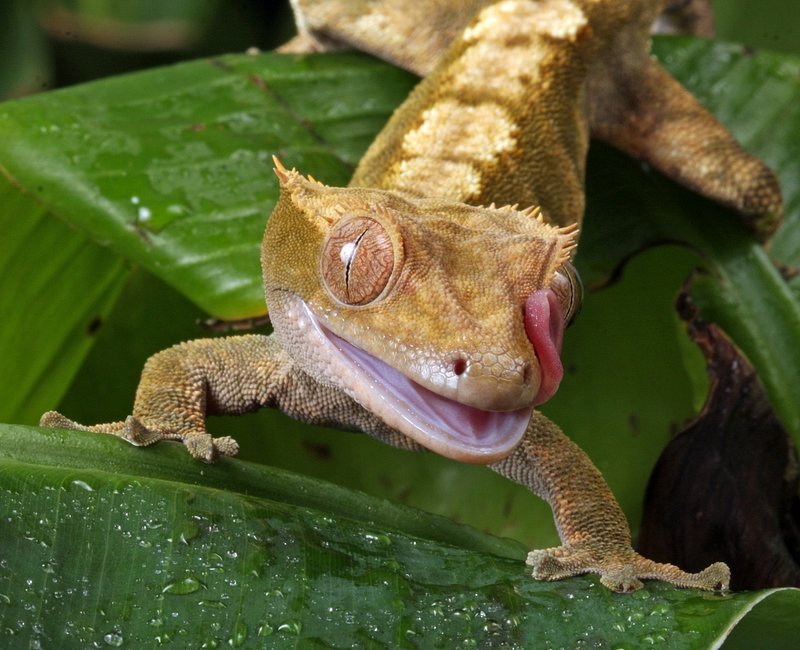
Crested Gecko Care Guide
Housing
The minimum enclosure size for an adult crested gecko is:
Length: 45cm × Depth: 45cm × Height: 60cm (18″ × 18″ × 24″).
Popular terrariums of this size include the Exo Terra Small/Tall Terrarium and HabiStat Glass Terrarium.
However, this is a minimum, not a maximum! Crested geckos are active, arboreal animals that spend much of their time climbing and exploring. If you have the space, we would always recommend providing a larger enclosure, particularly one with additional height.
Crested geckos generally reach their adult size at around 18–24 months of age, although growth rates vary between individuals.
There’s no reason a hatchling cannot go straight into its adult enclosure, provided it’s appropriately furnished and you’re able to monitor its feeding and general health.
When housing a young gecko in a larger terrarium, it’s particularly important to provide plenty of hiding places, foliage and branches. This allows your gecko to move around its enclosure while still feeling secure.
As crested geckos are primarily solitary animals, we recommend housing them individually.
Lighting & Equipment
Crested geckos are crepuscular animals, meaning they’re most active around dawn and dusk, although they may also be active throughout the night.
In the wild, they spend much of their time amongst vegetation, where they’re exposed to lower levels of UV light than reptiles that regularly bask in direct sunlight.
Like other reptiles, crested geckos benefit from a consistent day/night cycle. We recommend providing approximately 10–12 hours of daylight, with all visible lighting switched off overnight.
A timer is a great way to maintain a consistent lighting schedule.
It’s also important to provide shaded areas throughout the enclosure, allowing your gecko to choose how much light it’s exposed to.
UVB Lighting
Although crested geckos can obtain vitamin D3 through their diet, we recommend providing appropriate UVB lighting to support healthy calcium metabolism and natural behaviours.
For the recommended terrarium size, we suggest a T5 2.4% Arboreal ShadeDweller UVB strip light, suitable for providing low-level UVB exposure when installed at the correct distance.
Popular options include:
- Arcadia ProT5 ShadeDweller Arboreal kits.
- Reptile Systems ECO T5 units with an appropriate UVB tube.
Crested geckos are generally considered a Ferguson Zone 1 species, so the aim is to provide low-level UVB exposure rather than the higher intensities required by basking species.
When upgrading to a larger enclosure, you don’t necessarily need a stronger UVB bulb. However, the positioning, distance and coverage should be reassessed to ensure your gecko can access an appropriate UVB gradient.
Crested geckos naturally move between exposed and shaded areas, so we recommend positioning the UVB towards one side of the enclosure and providing plenty of foliage to create areas of shade.
Remember that the percentage printed on a UVB bulb doesn’t necessarily reflect the amount of UVB reaching your animal.
Always follow the manufacturer’s installation and replacement recommendations, and ideally measure the output using a UV Index meter.
Heating
Crested geckos are ectothermic, meaning they rely on external heat sources to regulate their body temperature.
Providing an appropriate temperature gradient allows your gecko to move between warmer and cooler areas as needed.
The basking area, directly beneath the heat source, should be maintained at approximately 27–29°C, with cooler areas available throughout the enclosure.
It’s particularly important to avoid overheating crested geckos, as they are less tolerant of prolonged high temperatures than many other commonly kept reptiles.
Heat Sources
We recommend using overhead heating, such as a basking bulb or ceramic heat emitter, to provide warmth from above.
For the recommended terrarium size, we suggest using a suitable basking bulb in a dome fitting, positioned above the enclosure and controlled by an appropriate thermostat.
We recommend using a Microclimate or HabiStat dimming thermostat for basking bulbs. Alternatively, an EVO Connect or suitable day/night thermostat can be used to automate your heating, provided it has the appropriate dimming function.
Ceramic heat emitters can also be used where light-free heating is required, provided they’re controlled by a compatible thermostat.
The wattage required will depend on the size of your enclosure, ventilation, room temperature and the distance between the bulb and basking area.
All heat sources must be controlled by an appropriate thermostat to prevent overheating and keep your gecko safe.
Measuring Temperatures
The best way to measure basking surface temperatures is with an infrared thermometer, allowing you to check different areas throughout the enclosure.
We also recommend using a digital thermometer with a probe to monitor ambient temperatures, particularly in the upper and lower areas of the terrarium.
As crested geckos spend much of their time climbing, it’s important to monitor temperatures at different heights rather than relying on a single reading.
Night-time Heating
In most UK homes, additional heating overnight isn’t necessary, as crested geckos naturally experience a drop in temperature when the sun goes down.
However, if your home regularly drops below approximately 16°C overnight, supplementary heating may be required.
We recommend using a ceramic heat emitter controlled by a separate, appropriate thermostat.
Any night-time heating should produce no visible light, allowing your gecko to maintain a natural day/night cycle.
Humidity
Crested geckos originate from humid forest environments and require access to appropriate humidity levels to remain healthy.
We recommend a humidity range of approximately 60–80%, with natural fluctuations throughout the day and night.
It’s beneficial to allow humidity to rise after misting and gradually fall again before the next spraying session, rather than keeping the enclosure constantly wet.
Prolonged exposure to excessive moisture, particularly humidity above 90% combined with poor ventilation, can contribute to respiratory problems, fungal growth and other health issues.
Humidity can be monitored using a digital hygrometer, and appropriate levels can be maintained through manual spraying or an automatic misting system.
We recommend spraying the enclosure in the evening, allowing humidity to rise naturally before gradually decreasing throughout the following day.
If using a humidifier or fogger, it should only be used for short periods and should never leave the enclosure constantly saturated. These can be controlled using timers or suitable humidity controllers.
Adequate ventilation is just as important as maintaining humidity, as stagnant, excessively damp conditions can encourage bacterial and fungal growth.
Diet & Feeding Routine
Crested geckos are omnivorous and frugivorous, meaning they naturally consume a combination of insects and fruit-based foods.
In captivity, they benefit from a varied diet consisting of a high-quality prepared crested gecko diet alongside appropriately sized live insects.
At Repxotics, our crested geckos are fed a mixture of:
- Crickets.
- Locusts.
- Other appropriately sized live insects.
- Occasional cockroaches.
- Complete prepared crested gecko diets.
All feeder insects should be properly gut-loaded before being offered to your gecko. This means providing the insects with a nutritious diet so they pass those nutrients on to your reptile.
Live Feeding
Young crested geckos generally require more frequent feeding than adults due to their growth and development.
Hatchlings are usually offered appropriately sized small to medium crickets or small locusts, while adults can typically manage standard crickets or medium locusts.
As a general guide, feeder insects should be small enough for your gecko to catch and swallow comfortably.
The commonly used guideline of selecting insects no wider than the space between your gecko’s eyes can be helpful, but shouldn’t be treated as an absolute rule. The shape and type of insect, along with the individual gecko’s size and feeding ability, should also be considered.
Live insects are an important part of the feeding routine at Repxotics, providing enrichment through natural hunting behaviours and contributing to a varied diet.
We recommend offering live insects regularly alongside a suitable prepared diet, adjusting the frequency according to your gecko’s age, weight and body condition.
Always remove uneaten live insects that may disturb or potentially injure your gecko.
Prepared Diets
We offer a freshly prepared crested gecko diet approximately three times a week.
Popular options include:
- Repashy Crested Gecko Diet.
- HabiStat Crested Gecko Diet.
- Pangea Complete Gecko Diet.
- Blue River Complete Gecko Diet.
These diets are specially formulated to provide a balanced combination of nutrients, including vitamins, minerals and protein.
At Repxotics, we recommend offering a combination of prepared diets and appropriately sized live insects, rather than relying exclusively on one food type.
However, it’s important to use a nutritionally complete prepared diet as the foundation of your gecko’s nutrition, as not all fruit-based mixes are formulated to be complete foods.
Prepared diets should be mixed according to the manufacturer’s instructions and replaced regularly to prevent spoilage.
Treats
Treat foods can be offered occasionally, but shouldn’t form a significant part of your crested gecko’s diet.
Popular treats include:
- Small amounts of ripe, mashed fruit.
- Waxworms.
We recommend offering these no more than once every fortnight.
Fruit should only be offered in small quantities, as prepared crested gecko diets already contain a balanced combination of fruit and other nutrients.
Waxworms are particularly high in fat, so should be reserved for occasional treats rather than regular feeding.
Water
Fresh, clean drinking water should always be available.
We recommend providing a shallow water dish, ideally positioned somewhere easily accessible within the enclosure.
Crested geckos will also drink droplets of water from leaves and other surfaces after misting, which is another reason regular spraying is beneficial.
However, misting shouldn’t be considered a replacement for providing fresh drinking water.
Supplementation
Supplementation is an important part of crested gecko care, particularly when feeding live insects.
There are several reputable brands available, with popular options including:
- Arcadia EarthPro-A.
- Arcadia CalciumPro-Mg.
- Vetark Nutrobal.
- Zoo Med Calcium without D3.
- Zoo Med ReptiVite.
All live insects should be supplemented appropriately, taking into account the nutritional content of your prepared gecko diet and the UVB lighting provided.
Our original recommended rotation for a young gecko was:
- Days 1 & 2 – Calcium supplement.
- Day 3 – Multivitamin.
- Days 4 & 5 – Calcium supplement.
- Day 6 – No supplement.
- Day 7 – Calcium supplement.
However, this should be treated as an example rather than a universal schedule. Different supplements contain different concentrations of vitamins and minerals, and complete prepared diets already provide many of the nutrients your gecko requires.
It’s important to avoid excessive supplementation, particularly with vitamin D3, as this can be harmful.
Always follow the manufacturer’s instructions and adjust supplementation according to your gecko’s age, diet, UVB provision and feeding frequency.
Décor & Substrate
Décor & Enrichment
Décor isn’t just about making your terrarium look attractive. It plays an important role in your crested gecko’s physical and mental wellbeing.
Crested geckos are arboreal animals, meaning they spend much of their time climbing and moving through vegetation.
In the wild, they inhabit forest environments where branches, leaves and natural hiding places provide opportunities for climbing, exploring and resting.
We recommend providing a variety of branches, cork bark, climbing structures and foliage throughout the enclosure.
One of the most important features is a raised platform or branched area beneath the basking spot, allowing your gecko to access warmth when needed.
Branches and climbing structures should be arranged at different heights and angles, encouraging natural movement and helping to maintain healthy muscle development.
We also recommend providing plenty of artificial or live foliage to create shaded areas and hiding places.
Crested geckos often feel more secure in densely furnished enclosures, particularly when they can move between branches without being constantly exposed.
Any heavy décor should be securely positioned to prevent it from shifting or falling.
Bioactive Enclosures
Another popular way to keep crested geckos is in a bioactive terrarium.
A bioactive enclosure is essentially a living ecosystem, combining natural substrates, live plants and a clean-up crew of small invertebrates.
Popular clean-up crew species include springtails and suitable tropical woodlice, which help break down organic waste and decaying plant material.
Bioactive enclosures are often furnished with natural branches, cork bark and live plants, creating a more naturalistic environment for your gecko.
If you’re planning a bioactive setup, we recommend providing additional plant lighting, such as an Arcadia Jungle Dawn LED or a suitable equivalent.
This helps support healthy plant growth and maintain the enclosure over time.
It’s important to remember that bioactive doesn’t mean maintenance-free. Enclosures still require regular monitoring, spot cleaning, appropriate watering and general upkeep.
Substrate
A soil-based substrate is recommended for crested geckos and other tropical species, as it helps retain moisture and maintain appropriate humidity levels within the enclosure.
The substrate should remain slightly moist beneath the surface, but should never become waterlogged or boggy.
There should never be standing puddles of water within the terrarium. If the substrate becomes excessively wet, it should be allowed to dry appropriately or replaced where necessary.
Constantly saturated conditions can encourage unwanted bacterial and fungal growth, particularly in enclosures with poor ventilation.
Popular substrates include:
- ProRep Crestie Life.
- Arcadia EarthMix.
- Coco coir blocks.
- Other suitable tropical reptile substrates.
Coco coir is a popular and affordable option, although it may dry out more quickly than specialist substrate mixes designed to retain moisture for longer periods.
For bioactive enclosures, a suitable drainage layer beneath the substrate can help manage excess water and prevent the soil from becoming saturated.
Whatever substrate you choose, the aim is to maintain appropriate humidity while still allowing the enclosure to dry naturally between misting sessions.
