
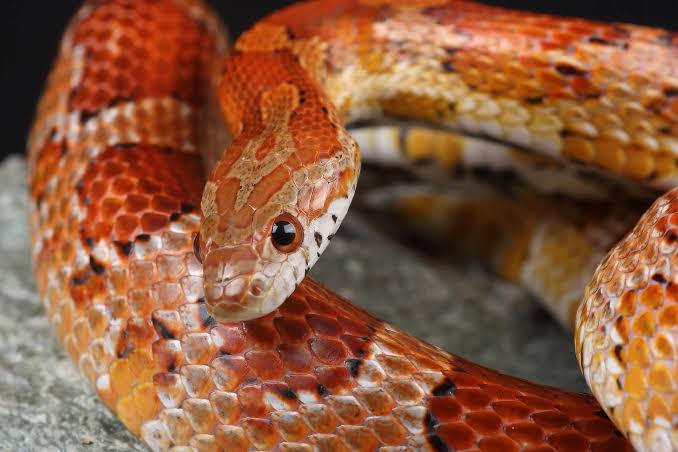
HOUSING
The minimum adult enclosure size for corn snakes is:
Length 4ft x Depth 2ft x Height 2ft (48” x 24” x 24”) The most popular vivarium of this size is the Vivexotic AAL Vivarium.
This in no way means that you can’t go bigger if you have the space, corn snakes can be quite active and would further be enriched by more space.
Corn snakes reach full size in approximately 3 years from their hatch, we never recommend starting your corn snake hatchling in anything smaller than 2ft (or an appropriately sized hatchling kit), we recommend starting them off in Vivexotic Reptihome Small’s or Habistat Hatchling Kits. You can put a hatchling snake into their adult size enclosure right away, but you want to make sure to clutter it with plenty of hiding places, foliage, and branches, to make sure the snake feels secure, you will also need to make sure there are no gaps where a baby snake can escape as corn snakes are very nimble as babies and can fit through very tight squeezes
LIGHTING & EQUIPMENT
Corn snakes are primarily diurnal animals, which means in the wild they would spend a portion of their day out in the sun soaking up the heat and UV, however they do like to dig and hide away, so you will be needing to offer multiple hides for access to shade. Like all reptiles, Corn snakes need a Day/Night cycle of 10-12hrs so all lighting must be turned off at night.
We recommend a T5 24w 6%/Zone 2 UVB strip light for 4’x2’x2’ vivarium’s, if going bigger the light would also need to be upsized depending on the vivarium. These bulbs are popularly available in 2 brands – Arcadia ProT5 kits or Reptile Systems ECO Units. All lighting must have protective heat guards to prevent the snake from hurting itself.
HEATING
All heat sources must be controlled by an appropriate thermostat to prevent overheating and keep your snake safe. The basking area (directly beneath the heat source) should be maintained at 26–29°C.
We recommend using basking bulbs for daytime heating and ceramic heat emitters (CHEs) for overnight heating, if required. Hatchlings can be kept on thermostatically controlled heat mats in smaller setups, but should be moved onto overhead heating when upgrading to a larger enclosure, typically between 12–24 months of age. Heat mats are not suitable for heating larger enclosures effectively, as they primarily provide localised surface warmth.
The most effective way to check temperatures throughout your enclosure is with an infrared thermometer, which allows you to measure surface temperatures in different areas. A digital thermometer with a probe can also be used to monitor the temperature at the basking area.
For a 4 × 2 × 2 ft vivarium, we generally recommend a 100–150w basking bulb, controlled by a Microclimate or HabiStat dimming thermostat. Alternatively, an Evo Connect or day/night thermostat with a dimming function can be used to automate your heating schedule.
Additional overnight heating is not usually necessary in most homes. However, if your room regularly drops below 16°C, you may need a ceramic heat emitter connected to a separate pulse-proportional thermostat to maintain suitable overnight temperatures.
DIET & FEEDING ROUTINE
Corn Snakes are completely carnivorous animals and can’t survive on anything other than a rodent/poultry-based diet, all of their food in this country is frozen-thawed. Corn Snakes are considered one of the best starter snakes because of how much they love to eat
Mice & Rats
The best food for corn snakes is mice, and its ideal to keep them on mice throughout their lives. We do not recommend a diet of rats.
Gerbils, chicks & other different foods
If you’re having problems with your snakes feeding and ruled out any health or environmental issues, you can always try some other foods such as Gerbils, Chicks & Multi-Mammates (Africa soft-fur mice), these foods should only be offered in moderation as their nutritional value and fat content is inappropriate for a staple diet. These prey items can be offered as treats on occasion to enrich your animal’s diet.
Schedule & Size Guide
Your snakes prey item shouldn’t exceed I and ½ times the width of your snakes’ widest part. A good indication that your snake may need to be moved up a food size is if you can no longer see the bulge of the food item in your snakes’ body after eating.
Snakes under 6 months are usually fed every 5 days, then it goes to weekly feeds after that point. When they mature (approx. 3 years old) or reach their suspected maximum size, you want to slow their feedings down to once every 10-14 days. Corn snakes can very easily get over weight if over fed so it is not recommended to feed adult snakes more often than this. If you do have an obese snake it can cause liver problems and other health problems in your animal. If you’re trying to slim an obese snake down it must be fed at least once a month.
Never put a baby/growing snake onto a diet unless recommended to by an exotic vet.
DÉCOR & SUBSTRATE
Decor
Corn snakes primarily need décor for health and enrichment purposes. They need to have a raised area below their basking spot to bring them closer to the heat, and branches/landscaping to climb on to help keep them fit and healthy and to prevent any muscle problems. You can also add fake plants/foliage to help create shaded areas.
You need to offer this snake multiple hides to keep them comfortable. We recommend a minimum of 3 hides.
Substrate
Corn snakes can be kept on a wide variety of substrates, they’re a versatile snake and providing their humidity and temperatures are correct they thrive easily on all types of substrate.
The most common substrate is lignocel, or “snake life” as it’s a dust free substrate that is great for burrowing, it also changes colour slightly when it has been soiled. Aspen is also another popular choice; however, it is not dust free like lignocel is.
If going bioactive with this species we recommend using an Arid Earth Mix with orchid bark for added texture, you can also mix moss and other kinds of coco-fiber with it to create an enriched substrate, when doing this you must keep an eye on your humidity levels.
